How to Answer Behavioral Interview Questions

How to Answer Behavioral Interview Questions

Behavioral interview questions represent the most predictive assessment method that organizations use to evaluate candidates for management and leadership roles. Unlike hypothetical questions that ask what you might do, behavioral questions require you to describe what you actually did in specific past situations.

For mid-level professionals transitioning into leadership positions, mastering these responses becomes essential because they reveal how you think, solve problems, and influence outcomes under real workplace conditions.

The challenge many candidates face isn’t a lack of relevant experience; it’s the inability to articulate that experience in ways that demonstrate leadership competencies. Hiring managers ask behavioral questions specifically to assess qualities like decision-making under pressure, conflict resolution, strategic thinking, and team development.

This guide provides frameworks, techniques, and examples that help you structure compelling responses that showcase your readiness for increased responsibility.

Understanding Why Organizations Use Behavioral Interview Questions

Companies invest heavily in behavioral interviewing because past behavior predicts future performance more accurately than credentials, references, or theoretical responses. When you describe how you handled a difficult team member, navigated a project failure, or influenced stakeholders, you provide concrete evidence of your capabilities.

The Competency Assessment Framework

Most behavioral questions target specific competencies that organizations have identified as critical for success in the role. For management positions, these typically include leadership and influence, strategic thinking, communication and collaboration, problem-solving and decision-making, adaptability and resilience, and accountability for results.

Understanding this framework helps you recognize what interviewers are actually evaluating. When asked about a time you disagreed with your manager, they’re assessing your communication skills, professional maturity, and ability to navigate authority relationships, all essential for someone who will manage others.

The Predictive Value of Specific Examples

Interviewers prefer detailed, specific stories over general descriptions of your approach because specifics reveal authenticity. Anyone can claim they’re a collaborative leader. Describing how you built consensus among three departments with competing priorities demonstrates that quality through evidence.

The more concrete your example, including context, challenges, your actions, and measurable outcomes, the more credible your response becomes. This specificity also makes your answers more memorable, which matters when interviewers compare multiple candidates.

The STAR Method Framework for Structuring Responses

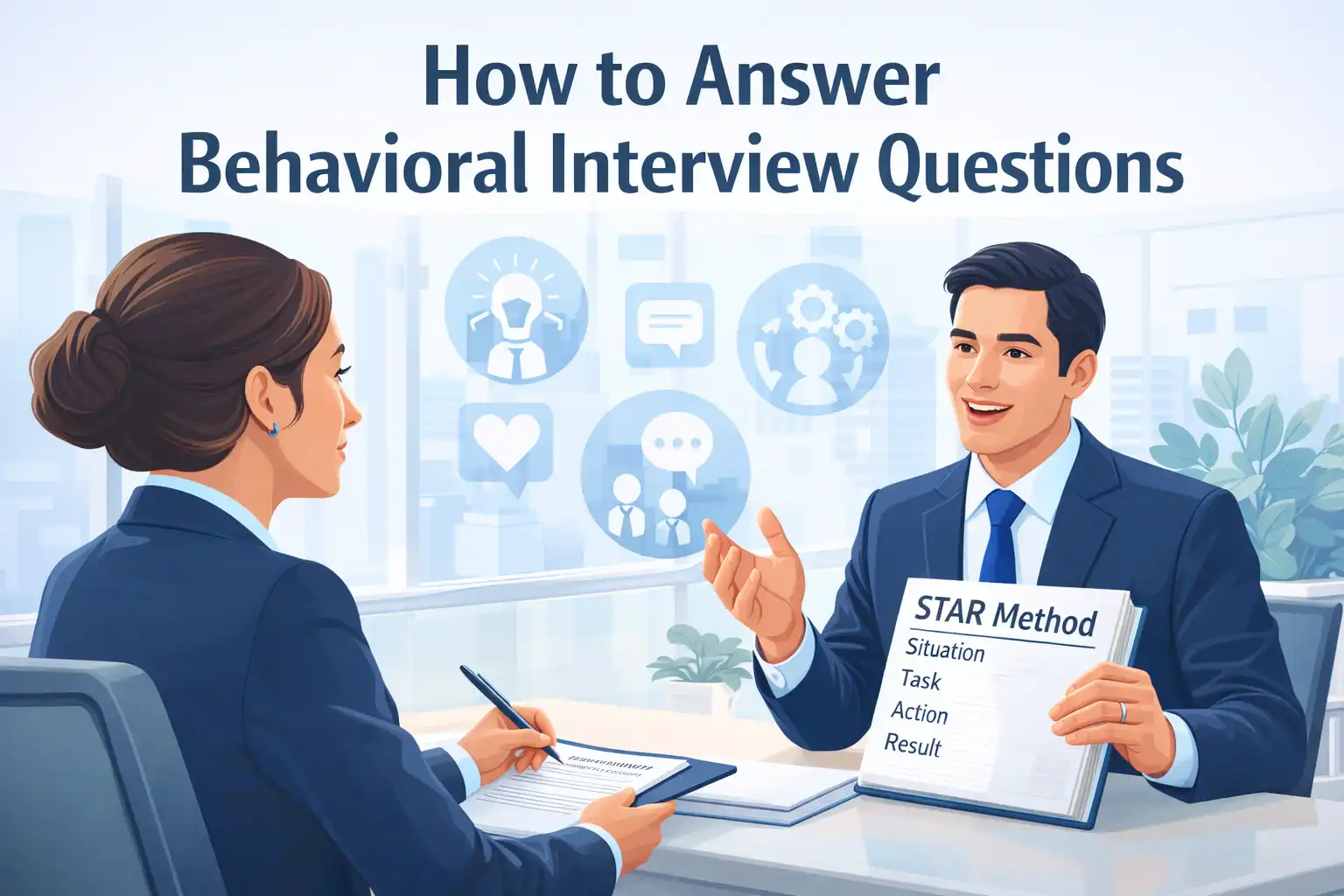
The STAR method provides the most widely recognized structure for behavioral responses: Situation, Task, Action, and Result. This framework ensures you provide complete answers that demonstrate both what you accomplished and how you accomplished it.

Situation: Establishing Context Efficiently

Begin by briefly describing the circumstances you faced. Provide just enough background that someone unfamiliar with your organization understands the challenge without getting lost in unnecessary details.

For example: “In my role as senior analyst at a healthcare organization, our department was implementing a new patient data system that required collaboration between clinical staff, IT, and administration. Three months into the rollout, we discovered that clinical staff were creating workarounds rather than using the new system, which created compliance risks.”

This situation setup takes three sentences but establishes the environment, the challenge, and why it mattered. Avoid spending two minutes on background that doesn’t advance your story.

Task: Clarifying Your Responsibility

Explicitly state what you needed to accomplish or what problem you needed to solve. This clarification helps interviewers understand your scope of responsibility and the expectations you faced.

Continuing the example: “As the liaison between our department and clinical operations, I needed to understand why staff were avoiding the system and develop a solution that would improve adoption without disrupting patient care.”

This task statement shows you understood both the immediate problem and the broader organizational constraint. It demonstrates systems thinking, which becomes increasingly important in management roles.

Action: Describing Your Specific Contributions

The action section forms the heart of your response and should consume the majority of your answer time. Detail the specific steps you took, the reasoning behind your decisions, and how you influenced or collaborated with others.

Use first-person language (“I did”) rather than collective language (“we did”) to clarify your individual contributions, especially for collaborative projects. Interviewers need to understand what you specifically brought to the situation.

In our example, “I first conducted informal conversations with fifteen clinical staff members across three departments to understand their concerns without putting them on the defensive about the workarounds. I learned that the system’s documentation features required redundant data entry that doubled their workload during patient interactions.

I compiled these findings into a brief report with specific examples and presented it to our IT implementation team and my director. I proposed piloting a modified workflow in one department that would streamline the documentation while maintaining compliance requirements. I volunteered to coordinate the pilot, including training staff on the modified approach and tracking adoption metrics weekly.

When the pilot showed ninety percent adoption within four weeks with positive staff feedback, I presented these results to leadership and recommended organization-wide implementation of the modified workflow.”

This action description demonstrates multiple competencies: initiative in investigating root causes, communication skills in gathering sensitive feedback, analytical thinking in identifying solutions, collaboration across departments, project management in coordinating the pilot, and influence in advocating for system changes.

Result: Demonstrating Measurable Impact

Conclude with specific outcomes that show your actions produced meaningful results. Quantify impact whenever possible using metrics like percentages, dollar amounts, time saved, or scope of effect.

Completing our example: “The modified workflow was implemented across all clinical departments within three months. System adoption increased from thirty-five percent to ninety-two percent, and compliance audits showed we met all documentation requirements. The chief medical officer cited this project in her quarterly address as an example of effective cross-functional problem-solving, and I was asked to join the steering committee for future system implementations.”

This result section provides concrete evidence of success through multiple measures: adoption rates, compliance outcomes, leadership recognition, and expanded responsibility. These details make your contribution credible and impressive.

Preparing Your Story Bank Before Interviews

Successful behavioral interviewing requires preparation. You cannot effectively construct detailed STAR responses on the spot without preparation, especially under interview pressure.

Identifying Your Strongest Examples

Review your career and identify eight to twelve significant experiences that demonstrate different competencies. Look for situations where you faced meaningful challenges, took initiative, influenced outcomes, or learned important lessons, including failures.

Strong examples often come from projects where something went wrong, and you helped correct it, times when you worked with difficult personalities or competing priorities, initiatives you started rather than tasks you were assigned, or situations where you achieved results despite resource constraints or organizational resistance.

For management-track candidates, prioritize examples that show leadership even in non-management roles: mentoring colleagues, leading projects or initiatives, influencing decisions or strategy, resolving conflicts or building consensus, or improving processes or team performance.

Mapping Stories to Common Question Categories

Behavioral questions typically fall into predictable categories. Map your prepared stories to these themes so you can adapt them during interviews.

Leadership and influence questions explore times you motivated others, influenced decisions without authority, or took charge during challenging situations. Prepare examples that show your ability to inspire, persuade, and guide others toward goals.

Problem-solving and decision-making questions assess how you analyze situations, evaluate options, and commit to courses of action. Choose examples that reveal your thought process, not just your conclusions.

Conflict and difficulty questions examine how you handle disagreement, difficult personalities, or professional setbacks. Select stories that demonstrate maturity, communication skills, and constructive resolution rather than avoidance or escalation.

Adaptability and learning questions look for evidence that you adjust to changing circumstances and grow from experiences. Include at least one example where something didn’t go as planned and you adjusted effectively, and one where you recognized a mistake and corrected course.

Results and accountability questions focus on your ability to deliver outcomes and take ownership. Emphasize examples with measurable impact and situations where you held yourself accountable for team or project outcomes.

Writing and Practicing Your Core Stories

Write out your eight to twelve core stories in full STAR format. This preparation serves multiple purposes: it forces you to think through details you might forget under pressure, helps you identify which elements most effectively demonstrate competencies, allows you to time your responses, and creates reference material you can review before interviews.

Practice delivering these stories aloud, ideally with a colleague who can provide feedback. Aim for responses that take ninety seconds to two minutes. Longer answers lose the interviewer’s attention; shorter ones typically lack sufficient detail to demonstrate competencies convincingly.

Techniques for Delivering Compelling Responses

Having strong examples matters, but delivery determines whether interviewers connect with your stories and perceive you as a strong candidate.

Leading With the Headline

Consider starting your response with a brief headline that orients the interviewer to your story before diving into details. For example: “I’d like to tell you about a situation where I inherited a demoralized team and improved both morale and performance within six months. Here’s what happened…”

This technique helps interviewers follow your narrative because they know where you’re heading. It also allows you to frame the story positively from the start, which influences how they interpret details.

Using Specific, Concrete Details

Generic language weakens behavioral responses. Compare these two action descriptions:

Weak: “I worked with the team to improve our processes and communication, which helped us perform better.”

Strong: “I instituted weekly thirty-minute team meetings focused specifically on identifying process bottlenecks. In the first month, we identified that approval delays from our director were creating three-day backlogs.

I proposed a decision framework that specified which decisions required director approval versus team-level authority, which she approved. This reduced approval-related delays by seventy percent.”

The specific details of meeting frequency and duration, the concrete problem discovered, the exact solution proposed, and the measurable outcome make the second version credible and memorable. Anyone can claim they improved processes; the specifics prove you actually did it.

Demonstrating Self-Awareness and Growth

The most impressive responses often include a brief acknowledgment of what you learned or would do differently. This reflection demonstrates maturity and a continuous improvement orientation.

For example: “Looking back, I would have involved our IT team earlier in the process. Their technical perspective would have identified the documentation issue sooner and saved us the first two months of poor adoption. That experience taught me to include technical stakeholders in project planning from the beginning, which I’ve applied to every implementation since.”

This reflection shows you extract lessons from experience and adjust your approach, exactly what organizations want in developing leaders.

Matching Energy and Enthusiasm to Content

Your delivery style should reflect appropriate energy for the story you’re telling. Discussing a crisis you managed should sound serious and focused. Describing a successful team initiative should convey genuine enthusiasm. Explaining how you handled a difficult personality should sound professional and measured.

Vocal variety, appropriate emotion, and authentic engagement with your own stories make you more compelling as a candidate. Monotone delivery of even strong examples reduces their impact significantly.

Adapting Your Stories to Different Question Angles

Interviewers rarely ask questions in standard formats. You need to quickly identify what competencies they’re assessing and select appropriate examples, even when questions are phrased unexpectedly.

Recognizing the Underlying Competency

Train yourself to hear past the specific wording to the underlying assessment. “Tell me about a time you had to work with someone difficult” assesses conflict resolution, emotional intelligence, and professionalism. “Describe a situation where you missed a deadline” evaluates accountability, communication under pressure, and problem-solving when things go wrong.

When you identify the competency being assessed, you can select the story from your preparation that most directly demonstrates that quality, even if you need to emphasize different aspects than you originally practiced.

Tailoring Emphasis Within Your Story

The same base experience can often address multiple question types by emphasizing different elements. A project where you led a cross-functional team through a system implementation could emphasize leadership and influence if asked about motivating others, stakeholder management if asked about working with difficult personalities, or adaptability if asked about adjusting to unexpected challenges.

Prepare your core stories thoroughly enough that you can shift emphasis based on what the question prioritizes, rather than having only one rigid version of each story.

Handling Follow-Up Questions Effectively

Strong interviewers will ask follow-up questions to probe deeper into your stories: “What alternatives did you consider?” “How did your manager react?” “What would you do differently?” “Why did you choose that approach?”

These follow-ups aren’t challenges to your credibility; they’re opportunities to demonstrate deeper thinking. Answer them thoughtfully and specifically. If you don’t remember certain details, acknowledge that honestly rather than fabricating: “I don’t recall the exact timeframe, but it was roughly a quarter” sounds more credible than inventing specific dates.

Follow-up questions often reveal what competencies the interviewer cares most about for this role. If they drill into your stakeholder management approach, that signals its importance. Adjust remaining answers to emphasize that competency when relevant.

Common Mistakes That Undermine Behavioral Responses

Even candidates with strong experience damage their candidacy through preventable response errors.

Using Hypothetical or General Answers

The most damaging mistake is responding to “Tell me about a time when…” with “I would…” or “I typically…” These responses completely fail to provide the behavioral evidence interviewers seek.

If you genuinely lack a specific example for a question, acknowledge that honestly and offer the closest relevant experience you do have: “I haven’t faced that exact situation, but I encountered something similar when…” This approach maintains credibility while still providing useful information.

Taking Too Long to Get to the Point

Spending three minutes on situation and task setup before describing your actions frustrates interviewers and often results in them interrupting before you reach the impressive parts of your story. Time yourself in practice to ensure your setup takes thirty seconds or less.

If you notice an interviewer’s attention drifting or they’re checking the time, you’re probably providing too much background detail. Edit yourself in the moment: “To move to the key actions I took…” and jump to your action section.

Using “We” Instead of “I”

Collaborative language obscures your individual contributions. Interviewers need to understand what you specifically did, thought, and accomplished.

Even in team situations, you can acknowledge collaboration while clarifying your role: “Our team of five analysts worked on this project, and I specifically led the stakeholder engagement and synthesized our findings into the final recommendations.”

This phrasing gives appropriate credit to the team while making your contribution clear and specific.

Lacking Specific Results

Ending stories without measurable outcomes significantly weakens responses. “And that solved the problem” tells interviewers nothing about the magnitude of your impact.

“System adoption increased from forty percent to ninety-five percent, saving approximately 200 staff hours monthly,” provides concrete evidence of meaningful impact.

If you didn’t track formal metrics in the moment, you can often estimate reasonable outcomes: “Customer complaints about that issue decreased noticeably, I’d estimate by about half based on our support ticket volume,” provides useful information even without precise data.

Speaking Negatively About Others

Even when describing conflicts or difficult situations, maintain professional language about colleagues, managers, or organizations. Stating “My manager was completely incompetent and refused to listen to anyone” raises red flags about your judgment and professionalism.

Instead, describe situations objectively: “My manager and I had different perspectives on the project approach. She prioritized speed, while I was concerned about quality assurance. I needed to find a way to address quality concerns within her timeline constraints.” This framing shows maturity while still explaining the challenge you faced.

Providing Only Positive Stories

Interviewers specifically ask about failures, mistakes, and difficult situations to assess how you handle setbacks. Claiming you’ve never failed or always succeeded perfectly signals either dishonesty or a dangerous lack of self-awareness.

Prepare at least two stories about genuine failures or mistakes, focusing on what you learned and how you improved afterward. These responses, when handled well, often impress interviewers more than success stories because they demonstrate growth orientation and accountability.

Addressing Specific Question Types for Management Roles

Certain behavioral questions appear frequently for management-track positions and require thoughtful preparation.

Leadership Without Authority Questions

Questions about influencing others without direct authority assess your ability to lead through expertise, relationship-building, and persuasion rather than positional power.

Strong responses demonstrate stakeholder analysis, strategic communication, coalition-building, persistence through initial resistance, and focus on shared goals rather than personal credit.

Example approach: Describe identifying key stakeholders and understanding their priorities, building support by connecting your initiative to their goals, addressing concerns and objections constructively, and achieving buy-in through demonstrated value rather than directive authority.

Conflict Resolution Questions

Questions about disagreements, difficult colleagues, or team conflicts evaluate emotional intelligence, communication skills, and the ability to maintain relationships under stress.

Effective responses show that you addressed issues directly rather than avoiding conflict, sought to understand others’ perspectives before pushing your own, focused on problems and solutions rather than personalities, maintained professionalism regardless of others’ behavior, and reached resolutions that preserved working relationships.

Avoid responses that position you as purely right and others as purely wrong. Even when you were correct on substance, acknowledge that you could have handled aspects of the communication differently.

Failure and Learning Questions

Questions about mistakes, failures, or times things didn’t go as planned assess accountability, resilience, and learning orientation. Strong responses demonstrate that you take ownership without deflecting blame, you extracted genuine lessons that changed your future behavior,

you acted quickly to mitigate damage once you recognized the problem, and you showed appropriate judgment about when to escalate versus handle issues independently.

The failure itself matters less than how you responded and what you learned. A mistake you caught quickly, addressed proactively, and learned from demonstrates more leadership capability than a smooth project that taught you nothing.

Strategic Thinking Questions

Questions about long-term planning, priority-setting, or resource allocation assess your ability to think beyond immediate tasks to broader organizational goals.

Demonstrate that you consider multiple stakeholder perspectives, evaluate tradeoffs between competing priorities, connect tactical decisions to strategic objectives, and anticipate downstream consequences of decisions.

These responses should show you think like a manager who balances multiple considerations, not just an individual contributor optimizing for your own efficiency.

Preparing for Industry-Specific Behavioral Patterns

Different industries emphasize different competencies in behavioral interviews, though fundamentals remain consistent.

Finance and Consulting Emphasis

Financial services and consulting firms particularly emphasize analytical rigor, client relationship management, performance under pressure, and comfortable authority with senior stakeholders. Prepare examples that demonstrate quantitative analysis informing decisions, professional polish in high-stakes situations, and the ability to synthesize complex information for executive audiences.

These industries also frequently assess cultural fit around work intensity and commitment. Examples should acknowledge demanding timeframes and high-pressure situations without complaining about reasonable professional expectations.

Technology Industry Focus

Technology companies often prioritize adaptability to rapid change, comfort with ambiguity and uncertainty, cross-functional collaboration across technical and non-technical teams, and data-driven decision-making balanced with speed.

Strong examples show you adjusted quickly to shifting priorities, translated effectively between technical and business stakeholders, and made sound decisions with incomplete information.

Technology behavioral interviews may also assess growth mindset and learning orientation more explicitly than other industries, so include examples of acquiring new skills or adjusting to unfamiliar domains.

Healthcare Administration Priorities

Healthcare organizations emphasize regulatory compliance and risk awareness, patient-centered decision-making, stakeholder management across diverse groups (clinical, administrative, technical), and ethical judgment in complex situations.

Examples should demonstrate understanding that healthcare decisions affect patient outcomes and organizational risk, the ability to navigate competing priorities between quality, efficiency, and cost, and respect for clinical expertise while contributing to administrative or operational value.

Healthcare behavioral interviews often include scenario-based questions about handling compliance issues or patient safety concerns. Prepare examples that show you prioritize these considerations appropriately.

Key Takeaways

  • Behavioral interview questions assess past behavior as the strongest predictor of future performance, particularly for evaluating leadership competencies in management-track candidates
  • The STAR method (Situation, Task, Action, Result) provides the essential structure for complete responses that demonstrate both what you accomplished and how you accomplished it
  • Prepare eight to twelve specific stories in advance that map to common competency areas, including leadership, problem-solving, conflict resolution, adaptability, and accountability
  • Use concrete, specific details rather than generic descriptions to make your responses credible and memorable. Numbers, timeframes, and exact actions prove your capabilities
  • Emphasize your individual contributions using “I” statements even in collaborative situations, clearly stating what you specifically did versus what others contributed
  • Practice delivering responses in ninety seconds to two minutes to provide sufficient detail without losing the interviewer’s attention or running out of time
  • Include at least two stories about failures or mistakes that demonstrate accountability, learning, and how you adjusted your approach based on those experiences
  • Demonstrate self-awareness by briefly acknowledging what you learned or would do differently, showing a continuous improvement orientation valued in leadership roles
  • Tailor story emphasis to the specific competency each question assesses, adapting your prepared examples based on what the interviewer prioritizes
  • Avoid common mistakes, including hypothetical responses, excessive “we” language, missing results, negative comments about others, or claiming you’ve never failed
  • Research industry-specific priorities to understand which competencies your target organizations value most heavily in behavioral assessments

What are behavioral interview questions?

Behavioral interview questions ask candidates to describe real situations from their past work experience. Instead of asking what you would do, employers ask what you did in a specific situation. This helps hiring managers evaluate leadership, problem-solving, communication, and decision-making skills based on actual evidence.

What is the STAR method in behavioral interviews?

The STAR method stands for Situation, Task, Action, and Result. It is a framework used to structure clear and complete answers to behavioral questions. Candidates explain the situation they faced, the task or responsibility involved, the actions they took, and the measurable results achieved.

How long should a behavioral interview answer be?

A strong behavioral answer typically lasts 90 seconds to 2 minutes. This length allows you to explain the situation, highlight your actions, and share measurable results without losing the interviewer’s attention.

How can I prepare for behavioral interview questions?

The best preparation is to create a “story bank” of 8–12 professional experiences that demonstrate leadership, teamwork, problem-solving, and conflict resolution. Practice structuring these stories using the STAR method so you can adapt them easily to different interview questions.

Learning how to answer behavioral interview questions effectively requires understanding that interviewers seek concrete evidence of competencies, not theoretical descriptions of your approach.

The most successful candidates prepare specific stories that demonstrate leadership capabilities through detailed examples of how they navigated real workplace challenges, influenced outcomes, and learned from both successes and setbacks.

Your behavioral responses serve as the most powerful evidence of your readiness for management responsibility. By structuring answers using proven frameworks, preparing diverse examples that showcase different competencies, and delivering responses with appropriate specificity and self-awareness, you provide interviewers with clear reasons to believe you’ll succeed in roles with greater responsibility.

The investment in thoughtful preparation transforms behavioral interviews from intimidating obstacles into opportunities to showcase the leadership capabilities you’ve developed throughout your career.

situs togel

sydney night

bento4d

situs slot

bento4d

bento4d

toto togel

slot resmi

bento4d

togel online

situs toto

bento4d

bento4d

guiadenoivos.saojosedojardimeuropa.com.br

toto slot

link-bento4d.com

bento4d

thepubtheatre

situs toto

situs gacor

mst.akwaibomstate.gov.ng

situs toto

situs slot

bento4d

world.skanray.com

situs toto

situs toto

situs toto

situs slot

mgpo.org

toto togel

fopsl.org/donate/

toto togel

bento4d

situs slot

form.eng.ku.ac.th

situs toto

situs slot

situs toto

situs slot

toto togel

toto

situs slot

toto slot

situs toto

situs toto

bento4d

beyond.globalpranichealing.com

bento4d

onhc.ca

situs gacor

situs toto

slot gacor

situs toto

toto

culturasbo.com

situs slot gacor

pafibengkuluutarakab.org

situs toto

situs toto

actkm.org

theantiguaguide.com/public

toto slot

situs toto

bento4d

slot resmi

situs togel

situs slot

toto slot

toto slot

situs togel

toto slot

bento4d

situs slot

toto slot

desaparhorboan.id/listing

momusi.org

thesolderingstation.com

pbumc.net

blog.actkm.org

situs slot

situs toto

situs gacor

situs slot

situs slot

toto

toto slot

situs slot

situs toto

situs slot

slot online

situs gacor

situs slot

www.promhotelsriccione.it

situs toto

www.blackbrooks.co.uk/pricing

situs slot

situs toto

slot thailand

link slot

www.telegramitalia.it

toto slot

situs toto

fcvfc.org

situs gacor

togel resmi

situs gacor

situs gacor

situs slot gacor

situs slot

link slot

ejournal.akbidbungabangsaaceh.ac.id

slot resmi

www.bestforinteriors.nl

situs slot

situs toto

toto slot

toto togel

lokvirsa.org.pk

situs gacor

link slot

situs toto

link slot

situs togel

situs gacor

situs slot

toto slot

toto

accesss.net

situs togel

situs slot

toto

situs toto

situs gacor

bento4d

nagaad.org/contact/

situs toto

link gacor

situs toto

situs slot

situs toto

toto slot

situs gacor

situs gacor

fet.uet.vnu.edu.vn

toto slot

toto slot

www.astina.co

toto

situs toto

situs slot

toto

link gacor

situs slot gacor

situs toto

toto

situs slot

toto togel

link slot

Similar Posts